




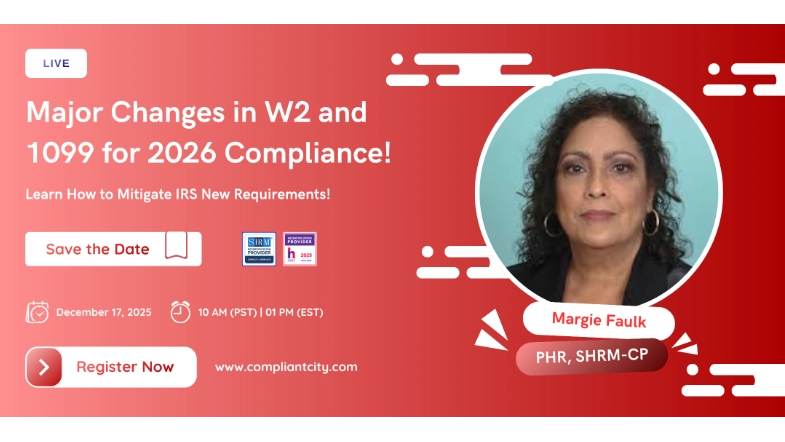
Major Changes in W2 and 1099 for 2026 Compliance Learn How to Mitigate IRS New Requirements
Major updates for 2026 W-2 and Form 1099 are being introduced under the “One Big Beautiful Bill Act” (OBBBA), including an increased 1099 reporting threshold and new reporting codes on the W-2 form for tips and overtime. These updates must be part of your compliance efforts. The changes will impact not only your payroll taxes but also the independent contractors protocol.
The One Big Beautiful Bill Act (OBBBA) has over 900 pages of provisions that are temporary and permanent. This has impacted organizations nationwide.
Employers will need to report the total amount of cash and non-cash tips reported by an employee and the occupation of the employee on the employee’s Form W-2. It does not end there. Likewise, businesses and other payors that issue Forms 1099 to tipped contractors will have to separately report designated tips and the recipient’s occupation on the Form 1099.
The OBBB Act instructs the IRS to update the applicable income tax withholding procedures and tax forms to reflect this new deduction and required occupation listing.
There are many challenges and confusion for Employers and employees on what needs to be done with these IRS changes. This training will outline the changes and compliance efforts that need to be put in place to avoid fines, penalties, and criminal sanctions.
Why you should attend:
IRS has provided draft documents to prepare Employers on the list of changes that have to be in place for 2026. They have also provided changes to some of the requirements due for 2025, which has confused about which requirements supersede. We will provide a step-by-step approach to ensuring compliance based on the IRS requirements. We will also offer resources that will help mitigate some of the challenges for 2025 and beyond.
Areas that will be covered during the Session
- Learn what OBBBA requirements are permanent and which are temporary
- Learn what requirements have been relaxed for 2025.
- Learn what W2 form changes need to be compliant by which date.
- Learn how independent contractors need to be aware of the changes in 1099 forms.
- Learn how to classify independent contractors vs employees
- Learn what codes and occupations are provided by the IRS.
- Learn what key items are put in place as we demonstrate updates from IRS draft forms
- Learn about resources is key when mitigating the IRS changes.
- Learn how to communicate these changes to employees effectively to meet compliance guidelines.
- Learn how your tax provider must be part of your team to assess how you are impacted as a company and as an individual.
Who should attend?
- All Employers
- Business Owners
- Company Leadership
- Compliance professionals
- HR Professionals
- Managers/Supervisors
After the live event, there will be a Q&A session where you can ask a question directly to our expert speaker. They will provide a clear and understandable response to help you better understand the topic.
Note: After completing your webinar purchase, please check your spam/junk folder in your email for the webinar joining link, which will be sent after the confirmation email.
Brief introduction to OBBBA-driven changes, what will impact W-2 and 1099 reporting in 2026.
Deep dive into new W-2 codes for tips, overtime premiums, occupation codes, and employer contributions.
Explanation of the new 2026 1099 threshold and reporting rules for tipped contractors, gig workers, and NEC/MISC updates.
How employers can prepare payroll systems, documentation, HRIS workflows, and mitigate IRS risks.
Open discussion and expert answers to attendee questions.
Online

This webinar explains the major IRS reporting changes coming in 2026, including new W-2 codes, updated 1099 thresholds, and employer compliance requirements under the OBBBA legislation. You will learn how to prepare your payroll and HR workflows to avoid penalties.
HR professionals, payroll managers, accountants, tax preparers, business owners, and compliance officers who handle employee reporting, wage statements, or contractor payments will benefit most from this session.
Yes. All registered attendees will receive the session recording, presentation slides, and any supporting documents within 24 hours of the webinar.
No. The webinar is suitable for all experience levels. The trainer will explain changes step-by-step, making it easy to understand even if you're new to W-2 or 1099 compliance.
Yes. The last portion of the event includes a dedicated Q&A where attendees can ask questions related to their payroll systems, reporting challenges, or compliance concerns.
This training gives employers, HR managers, payroll professionals, and compliance teams a complete understanding of the IRS changes coming in 2026 under OBBBA. By the end of this session, you will be able to confidently prepare your organization for new W-2 and 1099 reporting requirements, avoid penalties, and streamline your compliance processes.
You will learn:
- The new 2026 W-2 codes for tips, overtime premiums, and employer contributions.
- How to correctly report occupation codes in Box 14b.
- Updated rules for tip income reporting and categories of tipped employees.
- The new 1099 threshold and reporting changes for gig workers and contractors.
- How to prevent common IRS compliance errors in payroll and documentation.
- Steps to prepare payroll systems, HRIS platforms, and internal workflows.
- How to mitigate risks and stay fully compliant before deadlines.
This session is designed to give you clear, actionable guidance so your team is fully prepared for the 2026 reporting season — without stress, confusion, or last-minute compliance issues.


 Alert
Alert